
AgentSociety
by Tsinghua UniversityAgentSociety is a social simulator developed by Tsinghua University, using large language models (LLM) to simulate complex social behaviors and phenomena through human-like intelligent agents.
What is AgentSociety?
AgentSociety is a social simulator developed by Tsinghua University, leveraging large language models (LLM) to create intelligent agents with human-like minds. These agents are endowed with emotions, needs, and cognitive abilities, enabling them to simulate complex social behaviors in urban environments.
Main Features of AgentSociety
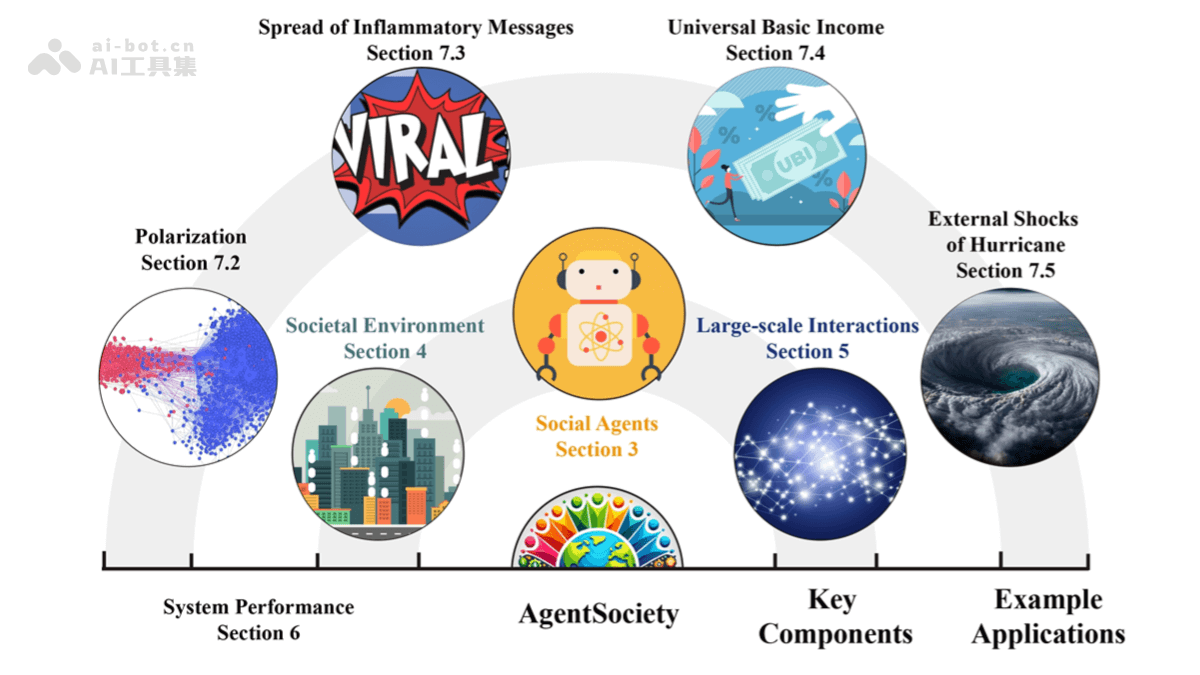
- LLM-Driven Social Agents: Constructs intelligent agents with human-like minds, endowing them with emotions, needs, motivations, and cognitive abilities.
- Realistic Urban Social Environment Simulation: Accurately simulates urban spaces, including transportation, infrastructure, and public resources.
- Large-Scale Social Simulation Engine: Employs an asynchronous simulation architecture and the Ray distributed computing framework for efficient, scalable agent interaction.
- Intelligent Social Science Research Toolbox: Provides tools for sociological research methods such as experiments, interviews, and questionnaires.
- Real-Time Interactive Visualization: Offers a real-time interface for monitoring and interacting with agents during experiments.
Technical Principles of AgentSociety
- Mental Level: Agents have stable individual profiles and dynamic personal states, ensuring personalized behavior patterns.
- Mind-Behavior Coupling: Agent behavior is driven by emotions, needs, and cognition, based on Maslow's hierarchy of needs and the theory of planned behavior.
- Behavioral Level: Agents perform simple and complex social behaviors, dynamically adjusting based on environmental feedback.
- Urban Space: Simulates urban road networks, areas of interest (AOI), and points of interest (POI).
- Social Space: Supports online and offline social interactions, simulating dynamic changes in social networks.
- Economic Space: Simulates macroeconomic activities, including employment, consumption, taxation, and interest mechanisms.
- Asynchronous Simulation Architecture: Each agent acts as an independent simulation unit, exchanging information through a messaging system.
- Distributed Computing: Based on the Ray framework and Python's asyncio mechanism, supporting distributed cluster expansion.
- MQTT Communication Protocol: Supports high-concurrency, low-latency message transmission among large-scale agents.
Project Address of AgentSociety
- Project Website: https://agentsociety.readthedocs.io/en/latest/
- Github Repository: https://github.com/tsinghua-fib-lab/agentsociety/
- arXiv Technical Paper: https://arxiv.org/pdf/2502.08691
Application Scenarios of AgentSociety
- Social Opinion Propagation: Simulating the spread and impact of information in social networks.
- Public Policy Response: Evaluating the impact of policies on individual and group behaviors.
- Social Polarization: Studying the mechanisms of opinion divergence and the formation of opposing camps.
- Natural Disaster Response: Simulating crowd behavior and social dynamics under extreme events.
Framework Features
Supported Tasks
Social Behavior Simulation
Policy Testing
Crisis Warning
Social Science Research
Urban Environment Modeling
Tags
Social Simulation
LLM
AI Agents
Urban Environment
Sociology
Distributed Computing
Behavioral Modeling
Policy Testing
Crisis Simulation
Research Tool
Getting Started
Pricing
free
Screenshots & Images
Primary Screenshot
Additional Images
Stats
0
Views
0
Favorites
249
GitHub Stars
Community & Support
Helping everyone find the best AI for their work and daily life through deep analysis and honest comparisons.
Categories
Stay Updated
Get notified about new AI tools, models, and insights.
© 2026 BestAI. All rights reserved.
 Invite Gmail Contacts