
Google Launches Agent Development Kit (ADK) for AI Agent Prototyping and Deployment
Google Agent Development Kit (ADK): Prototyping and Deploying AI Agents

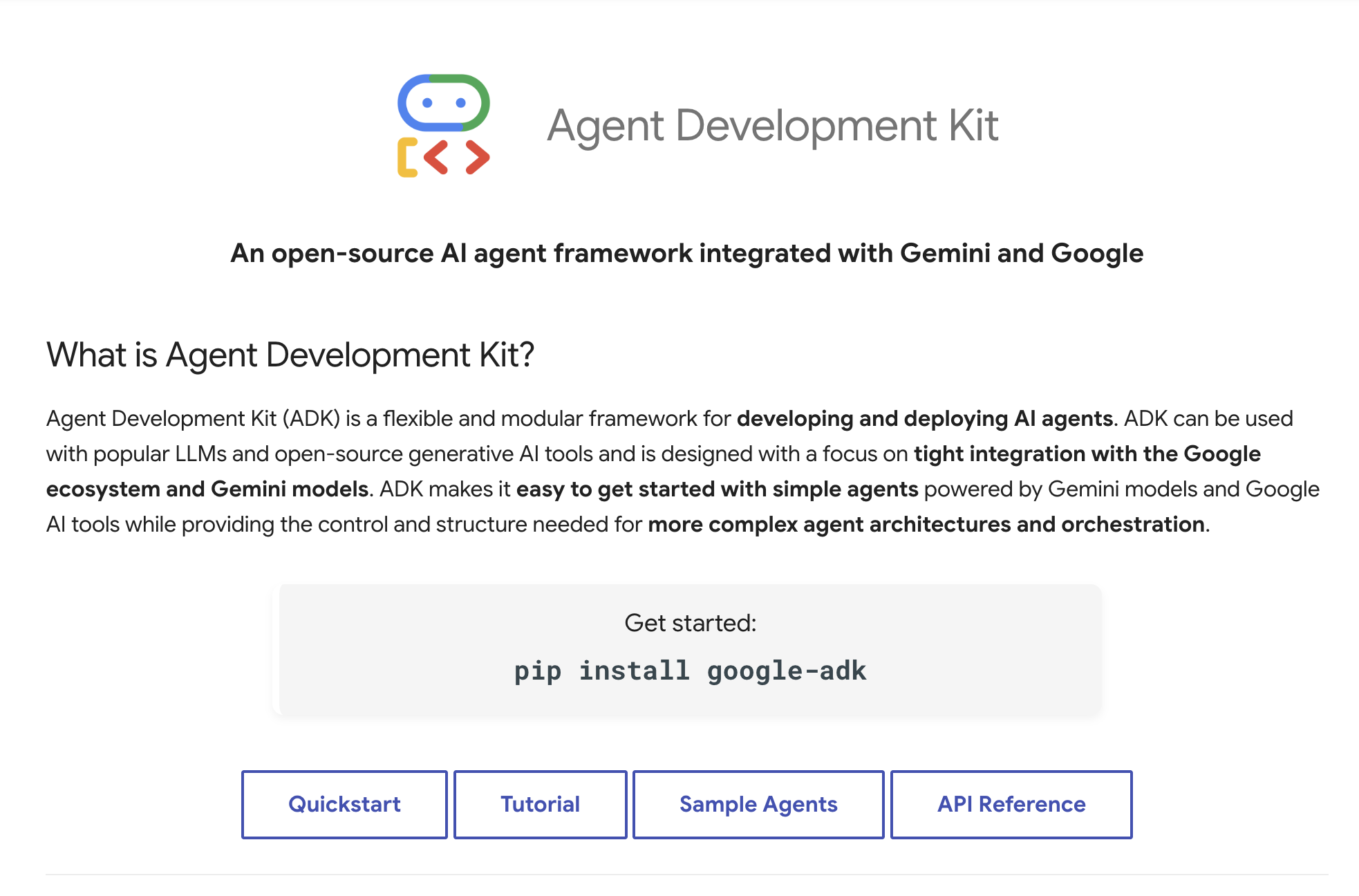
Google has introduced the Agent Development Kit (ADK), an open-source framework designed to simplify the creation, management, and deployment of multi-agent AI systems. ADK is particularly useful for enterprises looking to rapidly prototype and deploy AI agents without extensive recoding.
Key Features of ADK
- Code-First Approach: Developers can define agent behavior, tools, and orchestration logic directly in Python, ensuring maximum control and testability.
- Multi-Agent Support: ADK allows for the creation of modular and scalable applications by coordinating multiple specialized agents.
- Custom Tools and Memory: Developers can extend agents with custom logic and state management, enabling tailored solutions for specific use cases.
- Streaming Support: ADK supports real-time, bidirectional communication between agents, making it suitable for interactive applications.
- Integrated Developer Experience: ADK includes a CLI and visual web UI for local development, testing, and debugging.
- Deployment Ready: Agents can be containerized and deployed on various platforms, including Google Cloud’s Vertex AI Agent Engine, Cloud Run, and Docker.
Getting Started with ADK
To begin using ADK, developers can install the framework via pip:
pip install google-adkHere’s a simple example of creating and running a basic agent:
# my_agent/agent.py
from google.adk.agents import Agent
from google.adk.tools import google_search

root_agent = Agent(
    name="search_assistant",
    model="gemini-2.0-flash-exp",
    instruction="You are a helpful assistant. Answer user questions using Google Search when needed.",
    description="An assistant that can search the web.",
    tools=[google_search]
)
Run the agent using the CLI:
adk run my_agentEnterprise Applications
ADK is particularly beneficial for enterprises, offering:
- Rapid Prototyping: Enterprises can quickly build and test AI agents without extensive coding.
- Scalability: ADK supports the deployment of agents in production environments, handling scaling, security, and monitoring.
- Integration with Google’s AI Ecosystem: ADK integrates with Gemini models and Vertex AI, providing access to advanced AI capabilities.
Security and Governance
ADK includes built-in safeguards for enterprise-grade applications, such as output control, identity permissions, input screening, and behavior monitoring, ensuring secure and compliant deployments.
Future Developments
Currently, ADK supports Python, with plans to extend support to other programming languages. As an open-source project, ADK encourages community contributions, which will drive its evolution based on real-world use cases.
Conclusion
Google’s Agent Development Kit (ADK) provides a structured yet flexible framework for building, evaluating, and deploying AI agents. With its code-first approach, multi-agent support, and seamless integration with Google’s AI ecosystem, ADK is a powerful tool for enterprises and developers looking to innovate with AI-driven applications.
For more information, visit the ADK GitHub repository and the official documentation.
Sources
The AI discovery platform. Deep analysis, honest comparisons, and real metrics to help you find the best AI for any task.
Categories
Stay Updated
Get notified about new AI tools, models, and insights.
 Invite Gmail Contacts