
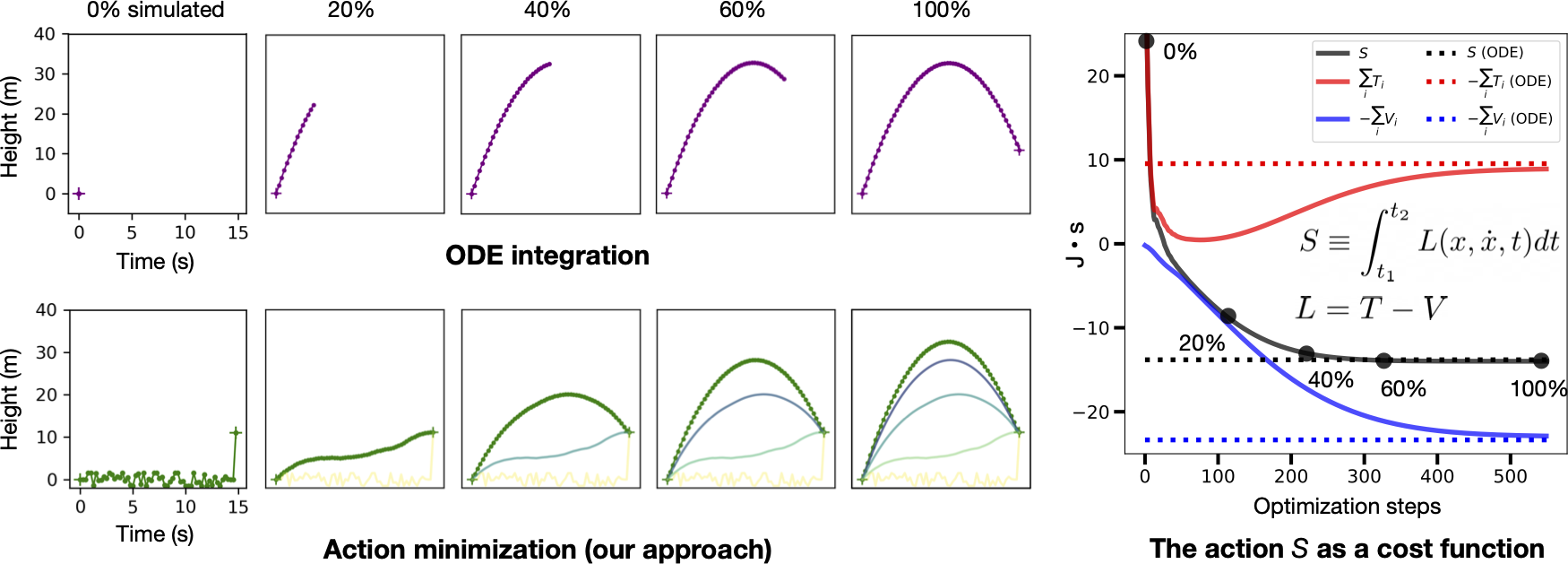
Gradient Descent Revolutionizes Physics Through Action Minimization
Gradient Descent and Action Minimization in Physics
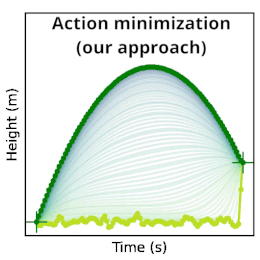
Gradient descent, a fundamental optimization technique in machine learning, has found a novel application in physics through the concept of action minimization. This approach leverages the principle of least action, a cornerstone of theoretical physics, to simulate physical systems.
What is Action Minimization?
In physics, the action is a scalar quantity that describes the evolution of a system over time. The principle of least action states that the actual path taken by a physical system is the one that minimizes the action. Traditionally, this minimization is performed analytically using tools like the Euler-Lagrange equation to derive equations of motion.
Gradient Descent in Action Minimization
Recent research, such as the paper titled "Nature's Cost Function: Simulating Physics by Minimizing the Action", proposes a computational approach to action minimization. Instead of analytical methods, the action is discretized and minimized using gradient descent. This technique has been successfully applied to simulate various physical systems, demonstrating results nearly identical to ground-truth dynamics.
Key Steps in the Process:
- Discretization: The action is discretized into a sum over time steps, allowing for numerical computation.
- Gradient Descent: The discretized action is minimized using gradient descent, where the gradient of the action with respect to the system's state variables is computed and used to update the state iteratively.
- Validation: The resulting dynamics are compared to known solutions, showing high accuracy.
Advantages of Gradient Descent in Physics
This approach offers several advantages:
- Flexibility: It can be applied to a wide range of physical systems, including those that are complex or chaotic.
- Computational Efficiency: Gradient descent provides a computationally efficient way to minimize the action, especially for systems where analytical solutions are difficult or impossible to obtain.
- Novel Simulations: The method has been extended to construct novel quantum simulations, opening new avenues for research in quantum physics.
Connecting Gradient Descent to Physically Observed Solutions
As discussed in "Connecting Gradient Descent to Physically Observed Solutions", gradient descent and its variants, such as weight decay, implicitly bias solutions toward minimal-energy configurations. This aligns with physical observations in equilibrium situations, where systems naturally tend to lower energy states.
Conclusion
The integration of gradient descent into action minimization represents a powerful synergy between machine learning and physics. By leveraging computational techniques, researchers can simulate physical systems with greater efficiency and explore new frontiers in theoretical and quantum physics.
 Invite Gmail Contacts