
Breakthrough in Neuromorphic Computing: Mimicking Neurons with Two Transistors
Breakthrough in Neuromorphic Computing: Mimicking Neurons with Two Transistors
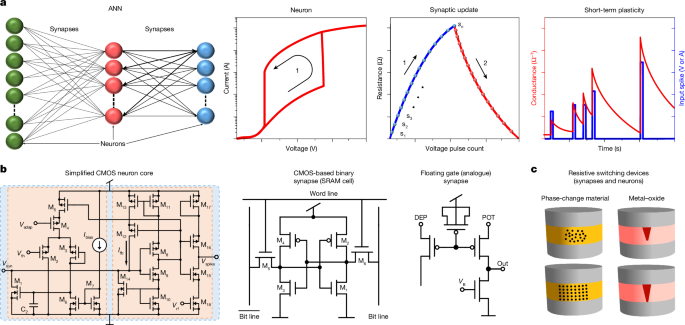
Researchers have developed a method to mimic spiking neural behavior using just two standard silicon transistors, a breakthrough in neuromorphic computing. This approach leverages a phenomenon known as "punch-through conditions," where charges build up in a semiconductor, allowing bursts of current to pass through even when the transistor is in the off state. This behavior closely resembles the spiking activity of biological neurons.
The team, a collaboration between researchers in Saudi Arabia and Singapore, configured the transistors to operate on the verge of punch-through mode. By adjusting the gate voltage, they could control the charge build-up, enabling the transistors to mimic neuronal spiking. The spiking frequency could vary by up to a factor of 1,000, and the system remained stable for over 10 million clock cycles.
This innovation has significant advantages:
- Simplicity: Only two transistors are needed, allowing for high-density integration on a single chip.
- Energy Efficiency: The design reduces energy consumption, as fewer components are required compared to traditional neuromorphic processors.
- Compatibility: The transistors are made using standard CMOS processes, making the technology easier to implement in existing systems.
However, there are challenges. The system requires additional hardware to control and reset the transistor states frequently. Additionally, spiking neural networks may not always match the performance of non-spiking networks in certain applications, and converting inputs into spiking signals can be complex.
Despite these hurdles, this research represents a promising step toward more energy-efficient AI hardware, which is critical as the energy demands of AI continue to grow. The study was published in Nature in 2025 (DOI: 10.1038/s41586-025-08742-4).
 Invite Gmail Contacts