

HippoRAG2
by Ohio State UniversityHippoRAG 2 is a Retrieval-Augmented Generation (RAG) framework designed to simulate human long-term memory dynamics and associations.
What is HippoRAG 2?
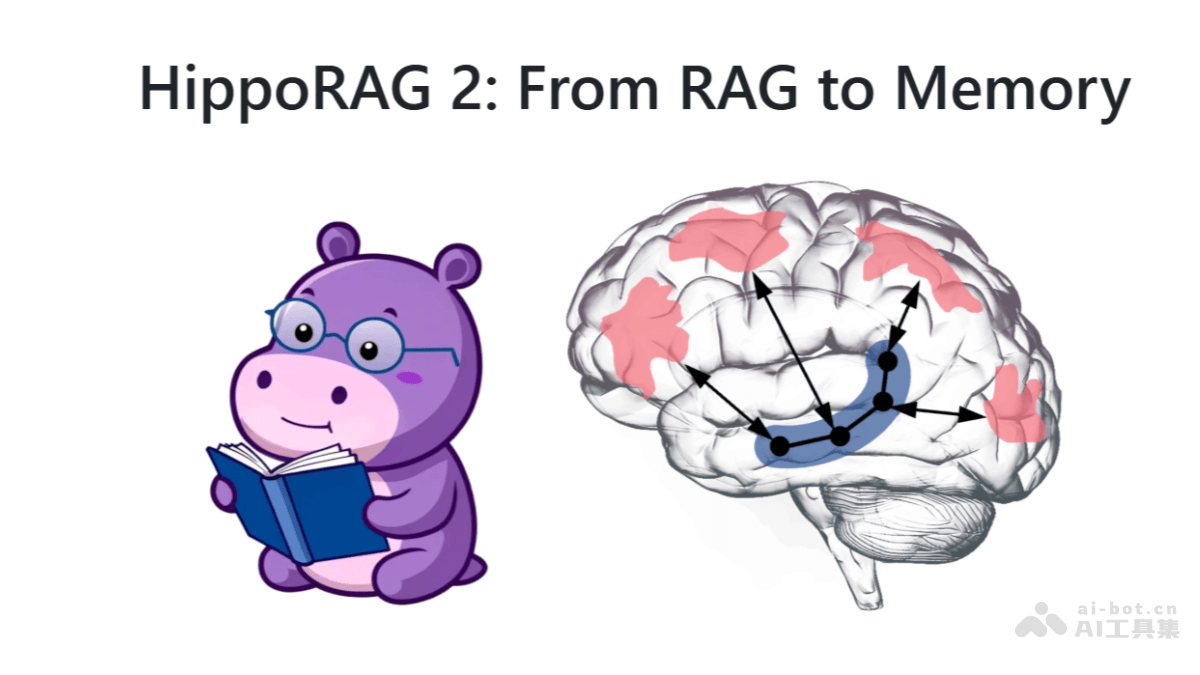
HippoRAG 2 is a Retrieval-Augmented Generation (RAG) framework developed by Ohio State University. It aims to overcome the limitations of current RAG systems in simulating the dynamics and associations of human long-term memory. HippoRAG 2 utilizes a personalized PageRank algorithm, integrating deep paragraph consolidation and more efficient use of online LLMs (Large Language Models) to bring RAG systems closer to the effectiveness of human long-term memory.
Key Features of HippoRAG 2
- Efficient Knowledge Retrieval and Integration: Based on deep paragraph consolidation and the construction of a knowledge graph (KG), it quickly retrieves knowledge related to queries and integrates it into the generation process.
- Multi-hop Associative Reasoning: Using the personalized PageRank algorithm, the system performs multi-hop reasoning, connecting scattered knowledge fragments to handle complex Q&A tasks.
- Context-Aware Retrieval: Based on deep interaction between queries and the knowledge graph, it dynamically adjusts retrieval results according to context, improving the accuracy and relevance of retrieval.
- Continuous Learning Capability: As a non-parametric continuous learning framework, HippoRAG 2 can absorb and utilize new knowledge in real-time without modifying model parameters, enhancing the system's adaptability.
Technical Principles of HippoRAG 2
- Offline Indexing: Uses LLMs to extract structured triples (subject, relation, object) from text paragraphs, integrating them into an open knowledge graph (KG). Detects synonyms based on embedding models and adds synonym edges to the KG, enhancing the connectivity of the knowledge graph. Combines original paragraphs with the knowledge graph to form a composite knowledge graph containing concepts and contextual information.
- Online Retrieval:
- Query Linking: Uses embedding models to match queries with triples and paragraphs in the KG, determining seed nodes for graph search.
- Triple Filtering: Filters retrieved triples based on LLMs, removing irrelevant information and retaining knowledge highly relevant to the query.
- Personalized PageRank Algorithm: Applies the personalized PageRank algorithm for context-aware retrieval based on the structure of the KG, dynamically adjusting the relevance of retrieval results.
- Paragraph Ranking and Q&A: Ranks paragraphs based on PageRank scores, using the top-ranked paragraphs as context input for the final Q&A model.
- Personalized PageRank Algorithm: One of the core technologies of HippoRAG 2, it simulates the multi-hop reasoning process in human memory, conducting deep searches in the knowledge graph to connect scattered knowledge nodes, better handling complex associative tasks.
- Deep Paragraph Integration: Deeply integrates paragraphs with nodes in the knowledge graph, preserving the contextual information of paragraphs and enhancing the semantic richness of the knowledge graph, making retrieval results more relevant and accurate.
Project Address of HippoRAG 2
- GitHub Repository: https://github.com/OSU-NLP-Group/HippoRAG
- arXiv Technical Paper: https://arxiv.org/pdf/2502.14802
Application Scenarios of HippoRAG 2
- Intelligent Q&A: Quickly answers complex questions, providing precise answers.
- Knowledge Management: Efficiently retrieves and recommends relevant content, improving knowledge utilization efficiency.
- Educational Assistance: Updates learning resources in real-time, aiding teaching and research.
- Medical Consultation: Retrieves medical knowledge, providing comprehensive health advice.
- Legal and Financial: Quickly integrates regulations and data, supporting professional decision-making.
Framework Features
Supported Tasks
Q&a
Knowledge Retrieval
Multi-Hop Reasoning
Context-Aware Retrieval
Tags
Retrieval-Augmented Generation
PageRank Algorithm
Knowledge Graph
Large Language Models
Natural Language Processing
AI Framework
Context-Aware Retrieval
Multi-hop Reasoning
Continuous Learning
Q&A Systems
Getting Started
Pricing
free
Screenshots & Images
Primary Screenshot
Additional Images
Stats
0
Views
0
Favorites
2200
GitHub Stars
Community & Support
Similar Frameworks
Helping everyone find the best AI for their work and daily life through deep analysis and honest comparisons.
Categories
Stay Updated
Get notified about new AI tools, models, and insights.
© 2026 BestAI. All rights reserved.
 Invite Gmail Contacts