

MindSearch
by Shanghai AI LabMindSearch
What is MindSearch?
MindSearch is an open-source AI search framework developed by the Shanghai AI Lab. It combines large-scale information gathering and organization capabilities. Leveraging the InternLM2.5 7B dialogue model, MindSearch can gather effective information from over 300 web pages in just 3 minutes, completing tasks that would typically take humans 3 hours. Using a multi-agent framework to simulate human thinking, it plans before searching, enhancing the accuracy and completeness of information. The project is fully open-source, allowing users to experience and deploy it locally for free.
Key Features of MindSearch
- Complex Query Processing: Breaks down complex user queries into smaller, manageable sub-questions for more precise information retrieval.
- Dynamic Graph Construction: Simulates human problem-solving processes by constructing directed acyclic graphs (DAGs), gradually refining problems and exploring solutions.
- Parallel Information Retrieval: Utilizes a multi-agent architecture to enable parallel searches for multiple sub-questions, improving speed and efficiency.
- Hierarchical Retrieval Strategy: Employs a coarse-to-fine retrieval strategy, first broadly gathering information and then selecting the most valuable pages for in-depth reading and extraction.
- Context Management: Effectively manages context information in multi-agent systems, ensuring coherence and integrity during information retrieval and integration.
- Response Generation: Synthesizes retrieved information to generate accurate, comprehensive, and in-depth responses to complex queries.
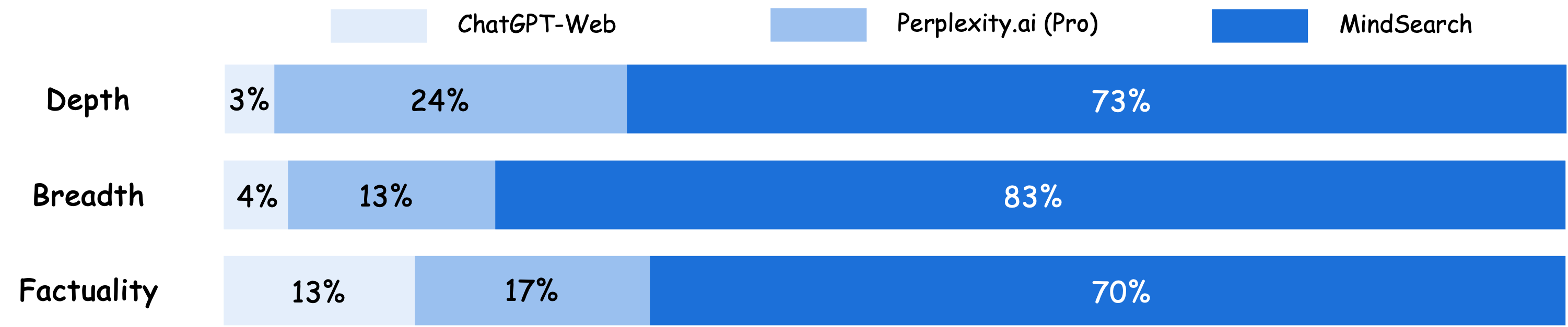
- Performance Enhancement: Significantly improves the quality of answers, including depth and breadth, in both closed and open-set question-answering tasks.
- Human Preference: Generates responses that align more closely with human preferences, making MindSearch's solutions more favored by human evaluators compared to other AI search engines.
Technical Principles of MindSearch
- WebPlanner: Acts as a high-level planner, decomposing user queries into sub-questions and simulating multi-step information-seeking mental models through dynamic graph construction (DAG).
- WebSearcher: Executes hierarchical information retrieval, gathering and summarizing valuable information from the internet based on sub-questions assigned by WebPlanner.
- Multi-Agent Collaboration: WebPlanner and WebSearcher operate as independent agents, handling problem decomposition and information retrieval tasks respectively, enabling parallel processing and effective information integration.
- Dynamic Graph Construction: Dynamically constructs logical graphs for problem-solving through code generation and execution, allowing LLMs to gradually refine problems and retrieve relevant information.
- Context Management: Ensures effective context state transfer between multi-agents, preventing the loss of critical information during retrieval and integration.
Project Links
- Official Website: https://mindsearch.netlify.app/
- Online Demo: https://mindsearch.openxlab.org.cn/
- GitHub Repository: https://github.com/InternLM/mindsearch
- arXiv Technical Paper: https://arxiv.org/abs/2407.20183
Application Scenarios
- Academic Research: Researchers can use MindSearch to quickly gather and organize extensive literature to support their studies.
- Market Analysis: Businesses can use MindSearch to collect market data, analyze competitor information, and monitor industry trends.
- News Reporting: Journalists can use MindSearch to gather background information on news events and quickly draft reports.
- Legal Research: Legal professionals can use MindSearch to collect relevant legal provisions, cases, and precedents to aid in legal analysis and case preparation.
- Technical Support: Technical support teams can use MindSearch to quickly find solutions and steps to resolve technical issues.
Framework Features
Getting Started
Screenshots & Images
Stats
Community & Support
Similar Frameworks
Helping everyone find the best AI for their work and daily life through deep analysis and honest comparisons.
Categories
Stay Updated
Get notified about new AI tools, models, and insights.
 Invite Gmail Contacts