
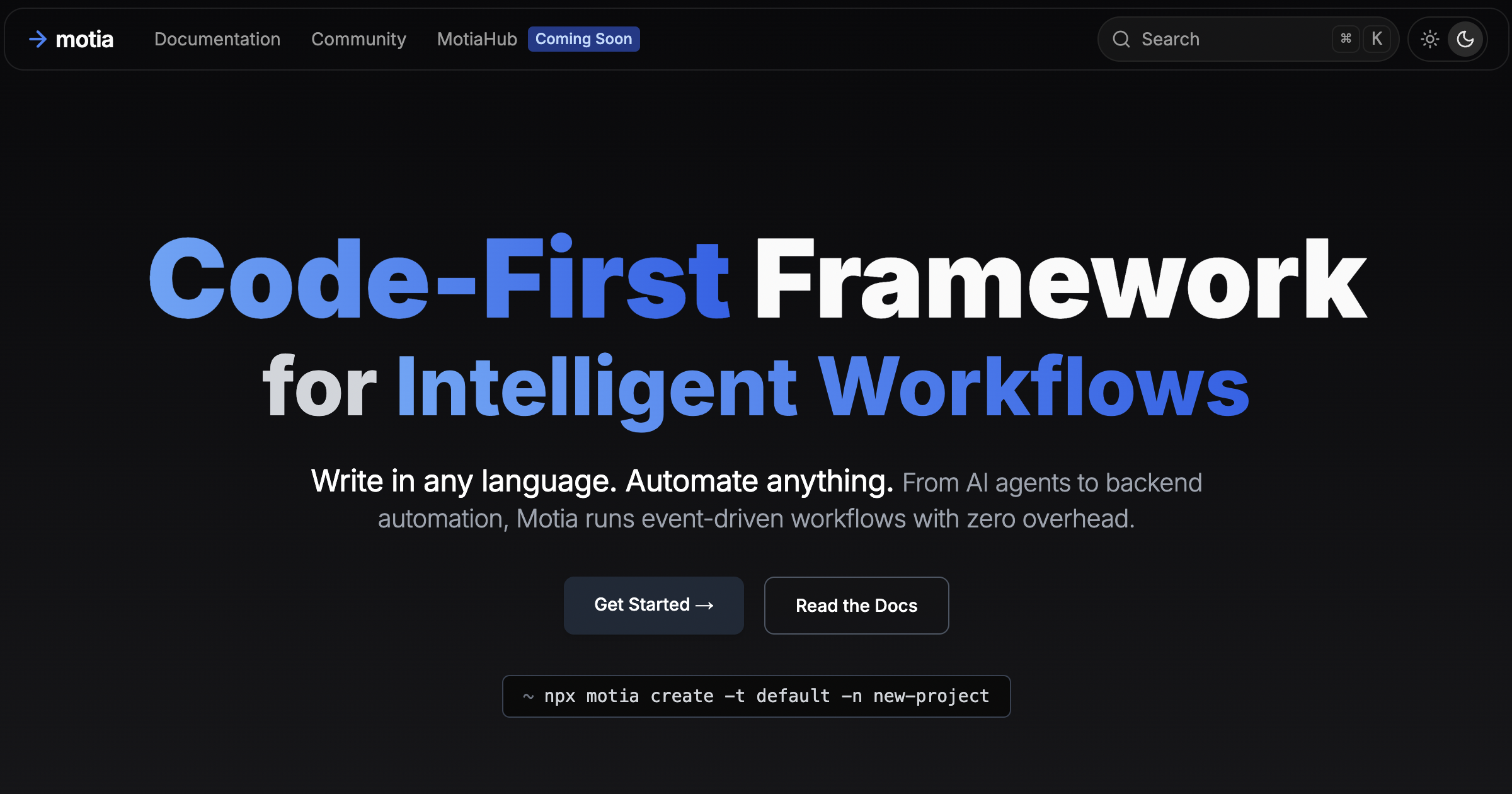
Motia
Motia is an AI Agent framework designed for software engineers, simplifying the development, testing, and deployment of AI agents with support for multiple programming languages like Python, TypeScript, and Ruby.
What is Motia?
Motia is an AI Agent framework designed for software engineers, simplifying the development, testing, and deployment of AI agents. It supports multiple programming languages such as Python, TypeScript, and Ruby, allowing developers to write agent logic in familiar languages without needing to learn proprietary domain-specific languages. Motia offers zero-infrastructure deployment, enabling one-click deployment of agents without complex configurations.
Key Features of Motia
- Zero Infrastructure Deployment: Motia provides one-click deployment without requiring complex Kubernetes or other infrastructure knowledge. Developers can easily deploy AI agents to production environments, lowering the deployment barrier.
- Multi-language Support: Supports multiple programming languages like Python, TypeScript, and Ruby. Developers can mix different languages within the same agent.
- Modular and Composable Steps: Features a modular design, allowing developers to create reusable components. Runtime automatically validates inputs/outputs, ensuring data accuracy and consistency.
- Built-in Observability: Offers visualized execution graphs and real-time logging, making it easy for developers to debug and monitor agent behavior. Developers can clearly see the execution flow and status of agents.
- Instant API and Webhooks: Supports exposing agent functionality via HTTP endpoints without writing additional API code. Developers can easily integrate agents with external systems.
- Full Control Over AI Logic: Motia does not restrict the large language models (LLMs), vector stores, or inference modes developers use. Developers can choose the tools that best fit their needs.
- Interactive Workbench: Motia Workbench is a browser-based development environment offering interactive flow visualization, real-time testing, and real-time log streaming, helping developers quickly develop and optimize agents.
- Rapid Iteration and Optimization: Motia’s design allows developers to quickly iterate on agent logic, experiment with different approaches, and continuously improve intelligent systems.
Technical Principles of Motia
- Code-first Development: Developers can write agent logic in familiar programming languages, not proprietary domain-specific languages (DSLs).
- Multi-language Mixing: Mix different programming languages within the same agent, such as using Python for machine learning, TypeScript for type-safe operations, and Ruby for API calls.
Project Links for Motia
- Official Website: motia.dev
- Github Repository: https://github.com/MotiaDev/motia
Application Scenarios of Motia
- Automated Workflows: Create GenAI-driven workflows to automate business processes.
- Complex Decision Systems: Build systems requiring complex decision-making and reasoning, such as automated customer support or travel planning.
- Data Processing Pipelines: Develop pipelines for data collection, processing, and analysis for business intelligence or research.
- Intelligent Automation: Implement advanced automation tasks like auto-replying to support emails or processing form data.
Framework Features
Tags
AI Agent
Development Framework
Multi-language Support
One-Click Deployment
Software Engineering
Automation
Event-driven Workflows
Code-first Development
Modular Design
Built-in Observability
Getting Started
Screenshots & Images
Primary Screenshot

Additional Images


Stats
0
Views
0
Favorites
1604
GitHub Stars
Community & Support
Similar Frameworks
Helping everyone find the best AI for their work and daily life through deep analysis and honest comparisons.
Categories
Stay Updated
Get notified about new AI tools, models, and insights.
© 2026 BestAI. All rights reserved.
 Invite Gmail Contacts